
In Scrabble, a word is not valid simply because it exists in French. It is only valid if it appears in the official list retained for the game. This distinction, often overlooked in family contexts, is the primary cause of disputes among players.
The ODS in Scrabble: a closed list, not a dictionary
The natural reflex when faced with a contested word is to open a common dictionary (Larousse, Robert) to settle the matter. This reflex leads directly to disagreement. In Francophone Scrabble, the reference is not the French dictionary but the Official Scrabble Dictionary (ODS), a closed list of accepted forms, published by Larousse under the auspices of the International Federation.
The ODS does not contain all the entries of a classic dictionary. Some common nouns absent from everyday language are included, while perfectly French words are excluded. The logic is that of an inventory of playable forms, not a description of the language.
To familiarize oneself with this logic and understand what distinguishes a playable word from a simply correct one, the basics of Scrabble on Cariboost detail the validity criteria applicable in play.
Word absent from the ODS but present in the dictionary: how to react
A player places COME on the board. The word exists, it appears in several dictionaries. However, according to the current edition of the ODS, it may not be accepted. This situation is common and generates frustration, especially when the player is convinced they are right.
The ODS changes with each new edition. ODS 9, applicable for the period 2024-2027, adds and removes words compared to previous versions. A word learned a few years ago may have been removed, and a word once rejected may now be accepted.
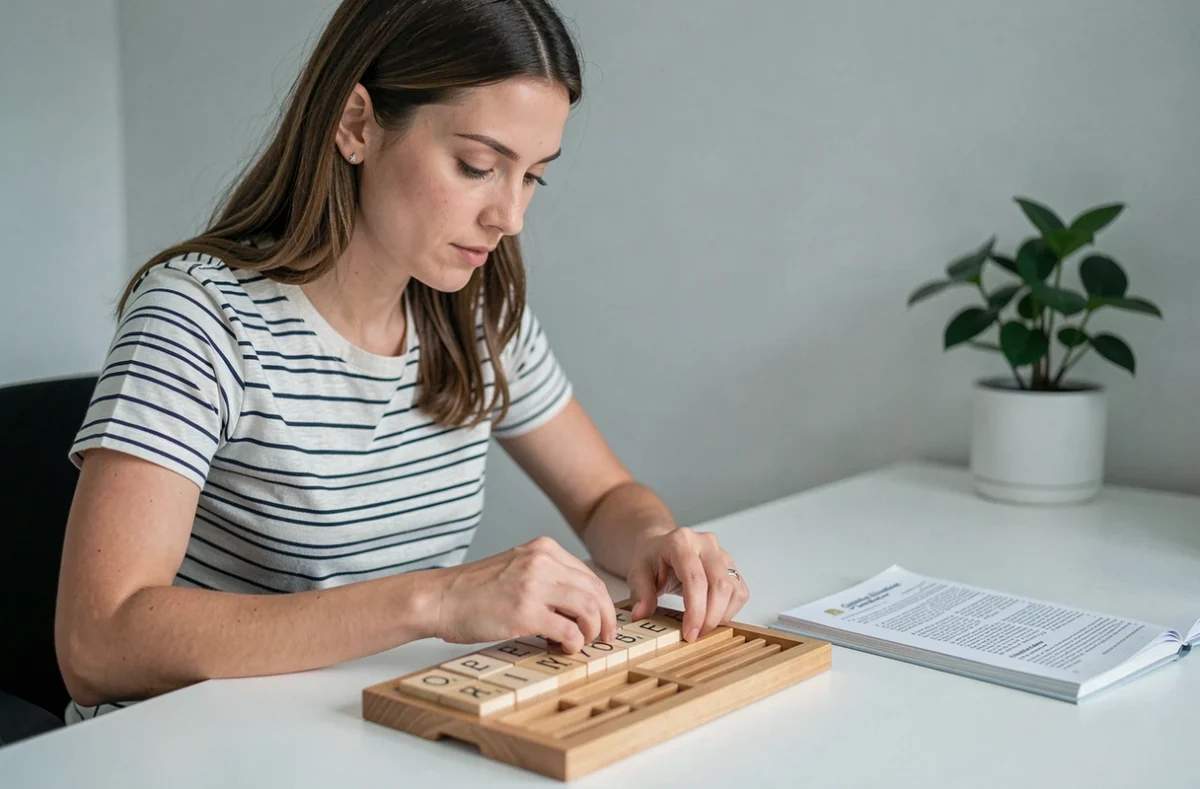
The practical consequence is direct: an unupdated verification app or a memory of an old game is not sufficient. Before contesting or defending a word, one must ensure that the verification tool is aligned with the edition retained for the current game.
Setting the rules before playing
The rules for contestation vary depending on the context. In organized competition, the procedure is codified: the opposing player contests, a referee checks in the ODS, and a sanction applies in case of an erroneous challenge. In friendly play, none of this exists by default.
To avoid disputes, three points should be defined before the first play:
- The reference dictionary: ODS 9, a precise app, or a verification site aligned with the current edition. All players must use the same source.
- The contestation procedure: who can contest, when (before or after the next draw), and what happens if the contested word is ultimately valid.
- The sanction in case of an invalid word: simple removal of letters, loss of turn, or point penalty. Setting this rule eliminates post-move discussions.
Secondary words on the board: the forgotten source of disputes
The majority of disputes concern the main word played. But in Scrabble, each letter placed potentially forms several words by crossing or extending letters already on the board. All these secondary words must be valid for the move to be accepted.
A player may place a perfectly accepted main word and see their move invalidated because a letter, by being placed next to an existing column, forms a two-letter word not listed in the ODS. This type of situation is common when playing in parallel, that is, by placing a word alongside an already present word.
Systematically checking the two and three-letter words formed by a move significantly reduces the risk of contestation. These small words are few in the ODS, and their list is quite stable from one edition to another, making their learning worthwhile.
ODS Vocabulary: memorizing high-impact words
Learning the entirety of the ODS makes no sense outside of high-level competition. However, targeting certain categories of words reduces both disputes and hesitations.
Short words with valuable letters
The letters J, K, Q, W, X, Y, and Z pose two problems: they score a lot of points but are difficult to place. Short words (two to five letters) that use them are few, making them easy to memorize. Forms like QI, WU, or DZO often surprise the opponent, but are indeed in the ODS.
Knowing these short words prevents blocking high-value letters on the rack for several turns. It also avoids reflexive disputes: an opponent discovering DZO for the first time will tend to refuse it, unless verification is provided.
Conjugations and inflected forms
The ODS accepts conjugated forms, plurals, and feminine forms. A verb in the imperfect subjunctive or an agreed past participle may surprise, but remains playable if it appears in the list. Conjugation represents a reservoir of words that many players underutilize, particularly rare forms of the simple past or subjunctive.
- Defective verbs (like clore, frire, paître) have partial conjugations: some forms simply do not exist in the ODS.
- Variable past participles (accrus, émues, dissoutes) count as full words and can be played as such.
- Forms in -ât, -ît, -ût of the imperfect subjunctive are often wrongly contested. They appear in the ODS for most common verbs.

The best way to improve Scrabble vocabulary is not through reading the dictionary, but through regular practice with a verification tool aligned with the current ODS. Each word rejected or validated during a game anchors itself in memory much more effectively than a list learned by heart. The simplest dispute to avoid is the one anticipated by agreeing on the rules before drawing the first letters.