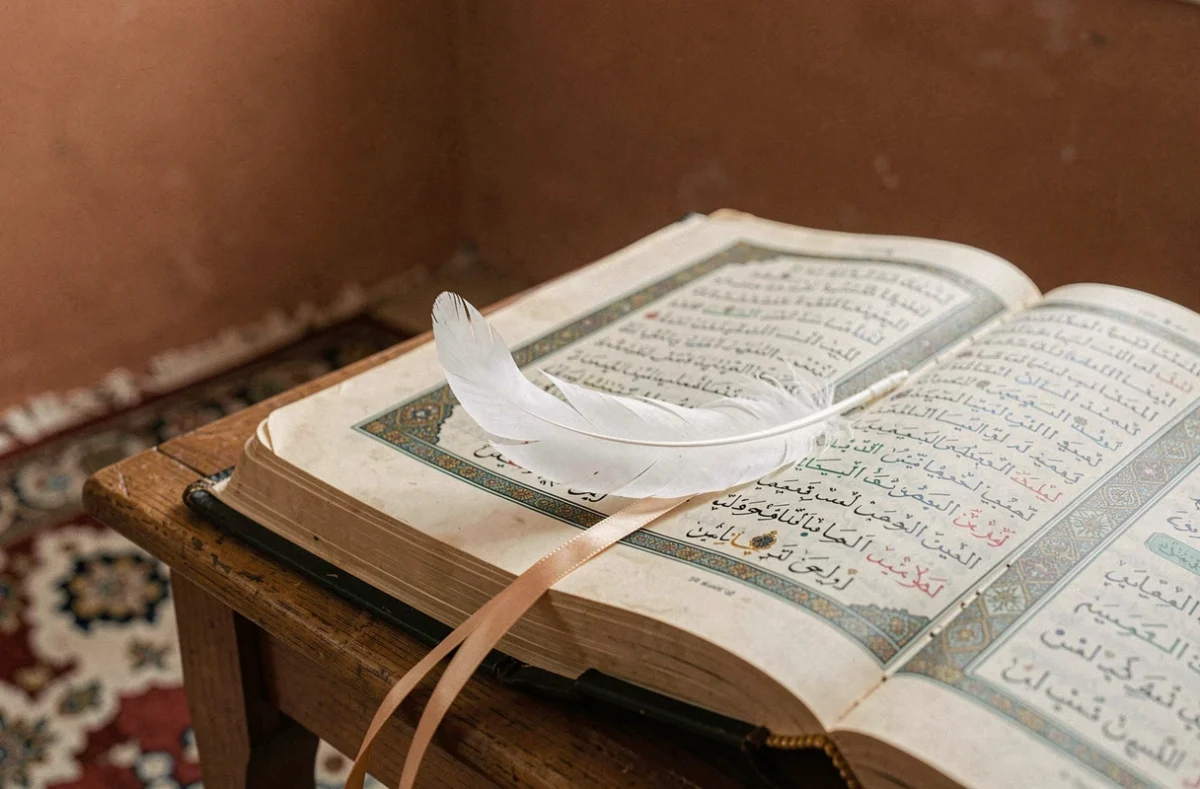
One comes across a feather lying on the floor of the living room, stuck near a window or slipped under a piece of furniture. The first reflex for many people of Muslim culture is to seek a spiritual meaning behind this discovery. The problem is that the answers circulating online often mix popular beliefs, universal symbolism, and Islamic teachings without ever drawing a boundary between the three.
Feather found in the house and superstition in Islam: what the texts say
Before discussing color or location, we must set a framework. The authoritative Islamic sources do not attribute any spiritual significance to a feather found in one’s home. Neither the Quran nor the recognized collections of hadith mention the feather as a vehicle for a divine message directed at an individual.
What does exist, however, is a clear warning against the practice known as ṭiyarah. This term refers to the superstition related to birds and natural signs. A tradition reported in the collection Sunan Abī Dāwūd equates divination through the flight or traces of birds to a form of divinatory practice. The text states that trust in Allah should replace this type of interpretation.
When exploring the meaning of finding a feather in Islam, it becomes evident that most available content does not make this distinction. They present interpretive frameworks (white feather = peace, black feather = wisdom) as if they belong to Islam, whereas they come from very different spiritual traditions.
Ṭiyarah and good omen: where the line is drawn in Islam

The nuance is often misunderstood. A recognized hadith distinguishes two attitudes towards a sign perceived in the environment.
- Ṭiyarah involves changing behavior or a decision because one has seen a bird, found an object, or heard a sound that is interpreted as a bad omen. This attitude is condemned because it attributes power to an object or animal that belongs only to Allah.
- Fa’l (good omen) is permitted. It involves appreciating an encouraging word, a name that carries hope, or a sign that brings optimism, without basing a decision on it.
- The difference lies in the effect on action: if the found feather provides a sense of comfort without altering a concrete choice, one remains in the realm of fa’l. If one cancels a project or makes a decision because of a black feather on the doorstep, one shifts into ṭiyarah.
In summary, feeling calm upon seeing a feather is not forbidden, but attributing predictive power to it is. The boundary is clear in the texts, even if it easily blurs in daily practice.
Istikhāra and tawakkul: the Islamic alternative to seeking signs
When going through a period of doubt, the desire to see signs everywhere is natural. One seeks external confirmation to move forward. Islam offers a structured framework to address this need without falling into the interpretation of found objects.
The prayer of istikhāra is the first tool. It involves asking Allah to guide one towards the best choice when hesitating between two options. One performs two units of prayer followed by a specific invocation. The response does not come in the form of a feather or a material sign, but through facilitation or an obstacle in the unfolding of events.
The second pillar is tawakkul, the active trust in Allah after mobilizing the concrete means at one’s disposal. One consults competent individuals, evaluates options, and then relies on Allah for the outcome. This approach replaces the search for omens in the environment.
Feedback varies on this point, but in scholarly tradition, no commentator recommends waiting for a physical sign (feather, animal, recurring number) as confirmation after an istikhāra. Guidance manifests through circumstances, not through an object placed on the floor.
White feather, black feather: where do these color frameworks come from
It is often read that a white feather symbolizes peace, that a black feather represents wisdom or spiritual connection, and that a red feather evokes passion. These associations do not come from Islam.
They stem from several distinct traditions. Indigenous cultures attribute a sacred dimension to eagle feathers related to communication with the spirit world. Modern spiritualism, developed in Europe and North America, popularized the idea that angels leave white feathers to signal their presence.
None of these color-meaning correspondence frameworks have a basis in Islamic texts. The Quran mentions birds several times (the hoopoe of Solomon, the birds of Abraha), but never to establish a symbolic code related to the color of their feathers.
Mixing these traditions with Quranic teaching poses a problem of doctrinal coherence. One can find a feather beautiful or comforting without applying an interpretive framework borrowed from another spirituality.
What to do concretely when finding a feather at home
The practical approach is simple. If a feather appears in the house, the most common causes are ventilation (open window), a cushion or duvet losing filling, or a bird that has approached an opening.
- Check the condition of pillows, duvets, and comforters stored in the concerned room
- Inspect vents and window sills for a nest or regular passage of birds
- If the feather evokes a positive feeling, welcome that emotion without making it a omen or a divine sign
- In case of doubt or concern related to a life choice, practice istikhāra rather than seeking an answer in an object
Finding a feather in one’s home has no documented spiritual significance in Islam. This observation does not detract from the beauty of the object or the comfort it may provide. It simply places the approach within the framework that the texts propose: guidance comes from prayer and effort, not from a feather resting on the tile.